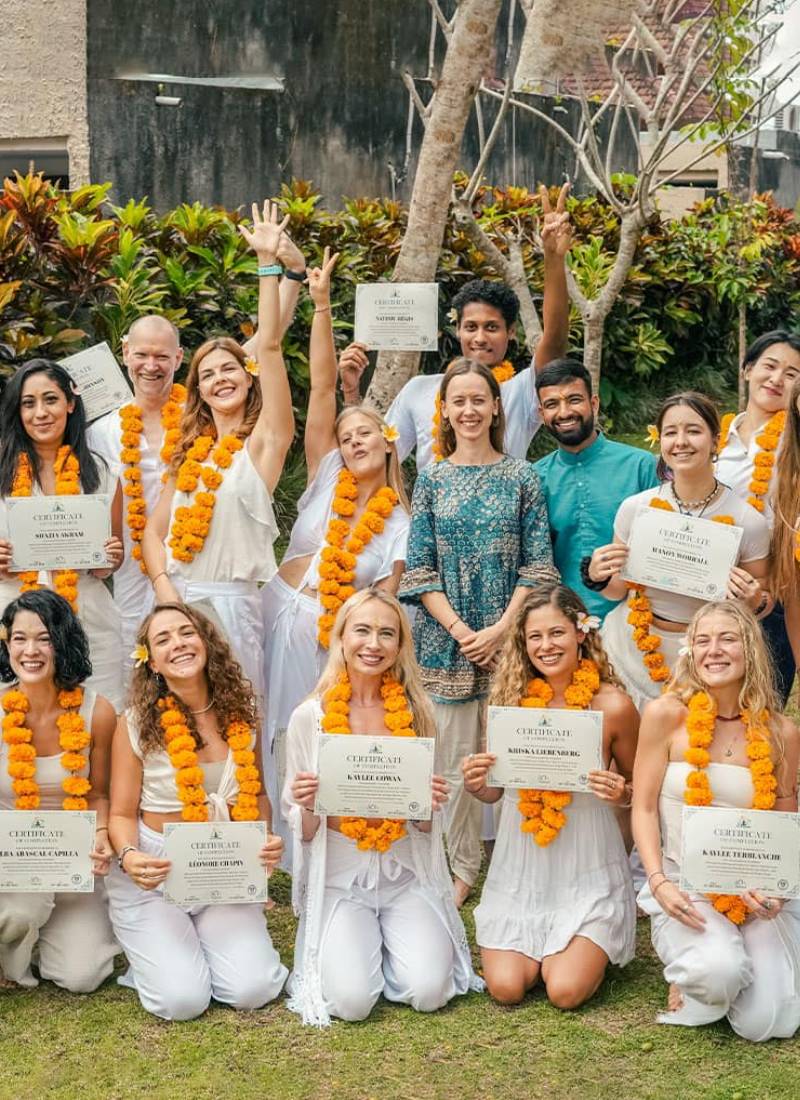
If you have just finished your Yoga Teacher Training Course, the idea of teaching your first class is probably daunting. Teaching a flawless class comes with experience, but that experience starts with the very first one. Delivering with confidence can be achieved with ease when you design a simple yet effective sequence, instead of trying to include complexity that can be difficult to implement.
While individual preferences should be the motivation to choose an asana style, Hatha yoga is a standard practice that is quite accessible to most beginners. It is slow with a steady build of progression, there is an opportunity to create better breath and bodily awareness, and with good assistance, it is a safe practice. Teaching one of the traditional Hatha sequences can give you the confidence to teach both optimally and creatively.
Hatha Yoga Sequence
A traditional Hatha Yoga sequence is a culmination of asanas working across different planes of movement. The various muscle groups are strengthened and stretched, and upon reaching Shavasana (corpse pose), the body feels open and the mind is at ease. Below is an example sequence that you can replicate or improvise upon for your yoga class.
Intention setting
Intention is the heart of your class. The first few minutes should be dedicated to cultivating presence, settling the mind into the practice, and setting an intention for the session. An affirmation or a prayer can be said to create a deeper awareness and connection.
Joint mobility
A good asana practice is built on the foundation of lubricating and conditioning the joints. Start with gentle joint mobility focusing on all the major joints- Ankle, Knee, Hip, Spine, Shoulder, Elbow, and the Wrist. Include 7-10 repetitions of each movement done with breath awareness.
Sun Salutations
A classic Hatha Surya Namaskar is the best way to warm up the whole body. You can start at a slower pace for a few rounds, and quicken the intensity to build up the heat for the last one or two rounds. Aim for 4-6 rounds, cuing for breath synchronicity throughout.
Standing asanas
Standing asana group is great for building leg strength and stability, while also improving balance and body coordination. You can sequence easier, more foundational asanas such as Tadasana (Mountain Pose), Urdhva Hastasana (Raised Hands Pose), Uttanasana (Standing Forward Fold Pose), and include a few challenging positions such as Virabhadrasana (Warrior) variations, Vrikshasana (Tree Pose), or Trikonasana (Triangle Pose).
2-3 standing asanas with a 5-10 breath hold is a good number to start with.
Seated asanas
Seated asanas help with increasing hip mobility, as well as back and leg flexibility. 2-4 asanas with longer holding can be really beneficial, especially for stiff beginners.
Asanas such as Paschimottanasana (Seated Forward Fold), Janu Sirsasana (Head to Knee Pose), Baddha Konasana (Butterfly Pose), Ardh Matsyendrasana (Seated Twist) can be practiced.
Prone asanas
Asanas performed in a pronated position are excellent for building back strength and opening the anterior chain. Caution must be exercised in order to avoid any unnecessary lumbar strain. Controlled range of motion without any pain should be prioritized over aesthetic alignment.
Bhujangasana (Cobra Pose), Shalabhasana (Locust Pose), Ustrasana (Camel Pose) are all pronated asanas accessible to beginners.
Supine asanas
When an asana is performed lying on the bacl, it is known as a supine asana. These asanas are usually done at the end of the Hatha sequence, to balance the backbends of the prone sequence.
Naukasana (Boat Pose), Setu Bandhasana (Bridge Pose), Uttanapadasana (Leg raises) are excellent for building core strength.
Supine postures can also be used as cool down asanas to restore the equilibrium at the end of class. Examples are Pawanmuktasana (Wing Releasing Pose), Ananda Balasana (Happy Baby Pose) and Supta Matsyendrasana (Supine Twist). Cool down asanas can be held for 30-60 seconds for maximum relaxation.
Shavasana
Shavasana is arguably the best, and the most important part of the practice. The Corpse Pose ensures complete relaxation of the body, allowing time to release any tension that has been acquired during the practice. Once the body is at ease, the mind follows. 5-7 minutes of Shavasana is a must for full integration of the asanas, and as a preparation for deeper reflection and meditation.
Once awakened from Shavasana, you can close the session with a small prayer or a few minutes of silence.
This is an example sequence that can give you the confidence to design and teach your very first class. Focus on giving clear and simple instructions, cue the breath, and always have modifications prepared beforehand.
Happy Teaching!